Montreal, Canada, 6/13/99, 69 laps
Black Weekend for Mercedes with lucky outcome
With both, the Canadian Grand Prix as well as the 24 hours of Le Mans, two important 4 wheel motorsport events took place this weekend. Mercedes was stunned after the big crash of their driver at LeMans and pulled their remaining cars out of the event for safety reasons. It has to be honoured that they chose in doing so and not risking men and material. Luckily, their driver at LeMans survived the air borne quad loop without any severe injuries. After a check at the hospital, he even returned to the race track.
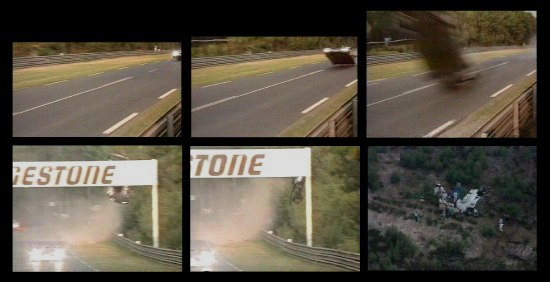
Quad backward loop of the Mercedes in LeMans
At the Grand Prix in Montreal, the prospects for McLaren were worse than ever this year. Häkkinen was on the second grid position, but all weekend long there seemed to be no way that he could get Schumacher's Ferrari. More likely, he had to fear an Eddie Irvine, who appears to be very much improved this season - performancewise and consistencywise. Häkkinen had the slightly better start, but Schumacher crossed the track and kept the Finn behind. Irvine could not overtake Häkkinen and Coulthard lost a place to Fisichella until the starting crash. The starting crash seems to be obligious for Canada. This time, Trulli thought it might be adviseable to brake very late on the inside of the track and that someone might give him room to go round the first corner. From reviewing the tape of the incident, my clue of the situation is that Trulli braked too late, but this was not the only reason for him losing control over his car. Frentzen, who lost two positions within the first meters to Barrichello and Alesi, tried to prevent others to overtake on the inside and shut the door a little bit by slightly moving towards the middle of the road. Trulli, who was side by side to Frentzen at that point, had to not only brake straight into the corner, but react to Frentzens move and had to steer to the left. Everone knows that when your driving on the edge, you can either brake and drive straight or steer round a corner, but if you want to brake at the maximum and go round the corner at the same time, you lose control of your car. In doing so, the back of Trulli's car snapped sideways and he lost control. Only afterwards, he went over the grass on the inside, slid back onto the track, touched Barrichello and rammed into the back of Alesi. Surprisingly, beside Trulli's car, there was no big damage. Barrichello made his way into the pits and Alesi tried to continue, but spun his car only meters from the first incident.
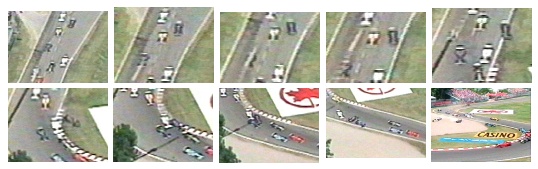
Trulli's late braking into the first corner and its result
After the mess was cleaned up quickly, the pace car nevertheless came out and gathered the field behind: Schumacher leading Häkkinen, Irvine, Fisichella, Coulthard, Frentzen and Herbert. Trulli was of course out of the race as well as Alesi and Wurz, whose drive shaft broke early. Not much later, a different part of the track drew attention to it: The chicane right before the cars come onto the starting straight. Returnee Ricardo Zonta was the first to bang into the wall after this chicane. This caused another pace car period. When the field was let go again, Schumacher could pull out a gap to Häkkinen, who was secure from Irvine. The Ulsterman had Coulthard in his slipstream, but was in control of the situation. Next one to bang into the aforementioned barrier was Damon Hill. The experienced Brit was however able to let his car roll a couple of meters out of the danger area and parked somewhat down the starting straight, so that the safety car was not needed this time. It is very easy to miss the braking point in front of that chicane and as a result you go too deep into the first turn of the chicane. To make it round, you have to steer much more compared to a normal go through that chicane. With this stronger steering manoeuver, the angle at which you enter the second part of the chicane is much bigger and if you have not decreased your speed at that point, there is no way but that into the wall. If you want to prevent this by a smaller amount of steer in the first turn, the danger is to go over the curbs on the inside of the second part of the chicane, which very likely makes your car spin. So either way you decide to opt for, your prospects are not very promising. The next one who had to decide either way was race leader Michael Schumacher. He missed the braking point, went over the inner curb, his back snapped to the right and crashed with heavy understeer into the wall.
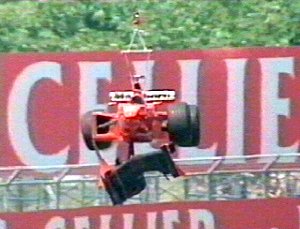
Schumacher's wreck after he crashed into the wall
The strongest bang into the ominous wall was the one of local hero Jacques Villeneuve. He went into the concrete at around a 75 degrees angle. But the Canadian was able to step out of his car unhurt. During the resulting yellow flag and later pace car period, many cars came into the pits for their tyre changes. So did leader Häkkinen and Irvine. Coulthard could not come in because his teammate occupied the McLaren pit and had to make his best by staying out. At that very moment, the pace car was not yet out, but the track was yellow flagged. That meant you could go nearly as fast as you wanted to go, but you were not allowed to overtake any car. Coulthard's bad luck was that he soon catched up to a slower Arrows and had to continue at the pace of that slower car. Häkkinen and Irvine, in contrast, could go into the pits with race pace and when they came back out, they gathered behind the pace car. This pit stop would have been a great opportunity for Coulthard to overtake Irvine, but the Arrows held him up a bit in the lap before he stopped and when he left the pits, he was even in front of Irvine and he could have pushed the nearing Irvine aside (remember Schumacher and Frentzen last year?), but he let Irvine pass and did not risc any penalty or danger. Some people might call that stupid, I call it fairness.
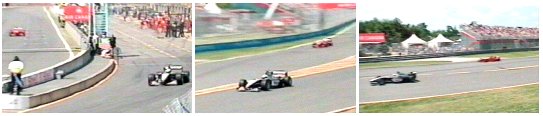
Coulthard clearly in front of Irvine at pit lane exit, but letting him through
During that pace car period, RTL commentator Heiko Waser just avoided to bring himself into deep troubles by using filthy language that would not quite conform with the demands of his sponsors, but he escaped by only speaking the first half of the word and then fled into mumbling some noises, before he regained his ability to speak words. Listen here!
The restart saw Häkkinen leading in front of the two back markers Badoer and Panis and then Irvine and Coulthard. Somehow Irvine missed the restart, because even those back markers pulled away from the Ferrari. After the race, Irvine stated that one of the backmarkers threw gravel on Irvine's tyres and he therefore came slow out of that corner. Coulthard was clearly faster, but Irvine tried to hold on to his position by staying on the inner left side. Coulthard was so much faster that he even could go round the outside. But not quite. Irvine was still at the inside of the back of Coulthards car. Because the Scotsman pulled right across the front of the Ferrari, Irvine had to go over the curbs of the first turn of the chicane. At the exit of the first turn, Coulthard had to go over the outer curb and that time Irvine was in the better position. He overtook Coulthart on the left and was ahead at the entry of the following right turn. But not quite! Coulthard was still at the back of the inside of Irvine's car. As Irvine pulled over, he left no room for Coulthard and the Scotsman hung onto his chances and did not brake so the two cars touched. Irvine was spun around and Coulthard had to go straight into the grass at the outside. But luckily both cars did suffer no damage and both could rejoin. Irvine was a little too ambitious in doing so and nearly was hit by the Sauber of Diniz, when the Brazilian came round that corner inmidst of the whole field. Irvine stopped again and let the field pass and then rejoined a few seconds after the whole field has gone by. Coulthard needed only a couple of seconds longer to rejoin than Irvine, but after the incident he went into the pits for a check of his car. An interesting point to mention at that stage of the race was that Williams driver Zanardi fought way back in the classement with a Minardi and was not able to overtake. This is less a sign of how difficult it is to overtake in Canada, it is more a sign of the poor performance of the '99 Williams driven by Zanardi.
The next stage of the race was mainly that of Eddie Irvine, who made his way insanely fast through the field and soon after the incident with Coulthard, he was in the points again. Johnny Herbert, the Stewart driver who had no good result this year so far was a little harder to overtake for Irvine. The Ferrari driver pulled out of the slipstream of Herbert right before the chicane with the famous wall, but he not quite could overtake him. Herbert stayed on the outside. Wisely, Irvine did not try to go through the chicane at the intended way at any cost, but rather he decided to go nearly straight over the grass onto the starting straight. Herbert consequently had to go that way as well and it was the best for both drivers. They created a cloud of dust, when they went through the dry grass, but they did no damage to their vehicles. While accelerating out of the chicane Irvine's car snapped sideways a little, but he kept control of it and after that manoeuver, Irvine was fifth.
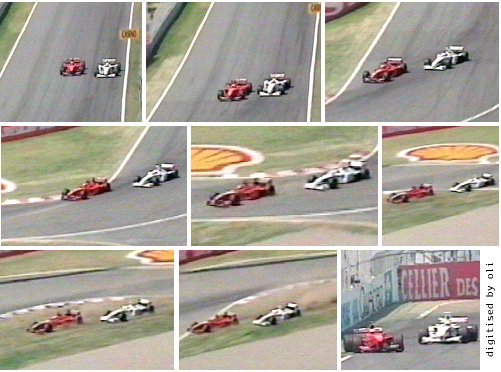
Irvine and Herbert making their way through the dust
The next victim of Irvine was Ralf Schumacher in an inferior Williams. Schumacher pulled to the right on the way to the one-and-only chicane. It is not for sure whether he did so to block the inside or to leave room for Irvine, but either way, Irvine easily passed on the outside and was fourth at that point. At the front, Häkkinen was still the leader, but the second placeman changed. After the pace car period of the Villeneuve crash, I mentioned the duell between the Minardi of Badoer and the Prost of Panis. These two played a role short afterwards. Irvine and Coulthard had gone out, so Fisichella and Frentzen inherited second and third. But then they had to pass the duo of backmarkers who were in a tense fight themselves. For a couple of laps, Panis did not give way to Fisichella. At the chicane, where nearly everything took place, Panis pulled to the left, but misjudged the situation a little bit. At that side, there was no way round Badoer, but Fisichella chose to follow Panis. When the Frenchman had to slow down to avoid the wall, Fisichella was caught out and had to slow down as well. Frentzen saw his opportunity and passed Fisichella as well as Panis. It did not help Fisichella that Badoer and Panis received a 10 second penalty for blocking, his second place was gone. Frentzen was lucky at that point, but only four laps from the checkered flag the luck had left him. For an unknown reason, his car slid off the track at high speed in the twitchy part of the circuit and crashed heavily into the barrier. Later it was anticipated that a broken brake disc could have caused the misery. Frentzen did not step out of his car by himself. The pace car came out as well as the doctor's car. Formula One circuit doctor Sid Watkins helped Frentzen out of the car and helped the German to walk away. Best wishes go to Frentzen, who developed this season from a boring, cold-hearted person in a not-so-bad-after-all Williams car of 1998 towards a consistently point scoring, reliable and sympathetic driver with a lot of understatement and experience, capable of dragging everything out of that Jordan, who comes next behind the Ferraris and McLarens. One can only congratulate Frentzen for his development, his team change and the way he performs this year - he would derserve a Grand Prix win ver y much. Probably he didn't change that much after all, but it is more the car and the team support that changed this year. Let's hope he will be fit for the next Grand Prix.
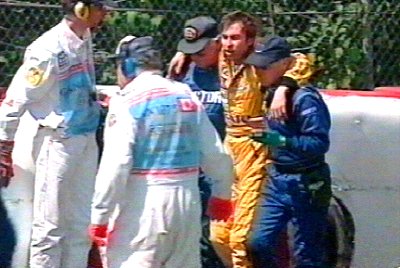
Frentzen after his crash helped by Sid Watkins
So we saw Häkkinen cross the finish line within the pace car period and noone could change positions until the end of the race. Second came Fisichella and Irvine was on a podium position after all. Fourth was Ralf Schumacher, who collects championship points not by the strength of his car, but more by consistently finishing, when others retire. The youngster deserves a better car and probably the engine of the '99 Le Mans winner BMW will bring the Williams chassis the desired strength next year. Johnny Herbert finally scored some points this year and showed that Barrichello is not the only good Stewart driver. Diniz receives the final point right in front of Coulthard, who was penalized to a 10 second stop in the pits for an unknown reason in the later part of the race. Gené brought home the Minardi and he did so not as last of the classified drivers. He left behind him the Prost of Panis and his teammate Badoer. Frentzen was classified despite his crash.
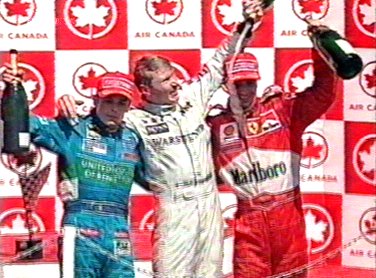
Fisico, Häkkinen and Irvine on the podium
My headline "black weekend for Mercedes with lucky outcome" relates on the one hand to the horrible crash of the Mercedes at Le Mans and the fact that the driver luckily could walk away uninjured. On the other hand, it is derived from Häkkinen's performance at Montreal that was at no point in the area of Schumacher's, but luckily for the McLaren team, Schumacher made a mistake and crashed into the wall, so that the (in Canada) inferior Häkkinen could inherit first position without any real fight for it. Let's see how McLarens and Ferraris performance will be at the next Grand Prix...
| 1. | Häkkinen | FIN | McLaren | 1h41:35.727 |
| 2. | Fisichella | ITA | Benetton | 0.700 |
| 3. | Irvine | IRL | Ferrari | 1.700 |
| 4. | R. Schumacher | GER | Williams | 2.300 |
| 5. | Herbert | ENG | Stewart | 2.800 |
| 6. | Diniz | BRA | Sauber | 3.700 |
| 7. | Coulthard | SCO | McLaren | 5.000 |
| 8. | Gené | ESP | Minardi | 1 lap |
| 9. | Panis | FRA | Prost | 1 lap |
| 10. | Badoer | ITA | Minardi | 2 laps |
| 11. | Frentzen | GER | Jordan | 4 laps |
| Not classified: | ||||
| Zanardi | ITA | Williams | 19 laps | |
| Takagi | JAP | Arrows | 28 laps | |
| Villeneuve | CAN | BAR | 34 laps | |
| M. Schumacher | GER | Ferrari | 40 laps | |
| De la Rosa | ESP | Arrows | 47 laps | |
| Hill | ENG | Jordan | 55 laps | |
| Barrichello | BRA | Stewart | 55 laps | |
| Zonta | ARG | BAR | 66 laps | |
| Wurz | AUT | Benetton | 69 laps | |
| Alesi | ITA | Sauber | 69 laps | |
| Trulli | ITA | Prost | 69 laps | |